


In 2001, The Atlanta Braves signed Junior Guerra as an undrafted free agent. Most Brewers Fans do not know that he started as a catcher. After being born in Venezuela, his journey to Milwaukee has been anything but typical. BREW MATHs breaks down his evolving style on the mound as he prepares for a role in the Brewers Bullpen.


In September of 2018 Adam McCalvy of MLB.com reported that Junior Guerra would be shifted to bullpen work moving forward. Counsell could be on to something with the move. When BREW MATHs began researching Guerra for this story, it became evident that there was an evolution in his pitching style underway. In this article we will detail the specifics of this process and use ‘evolution animations’ to highlight his growth…
CONTEXT
Guerra was born on January 16, 1985 and made his Major League Debut on June 12, 2015 with The Chicago White Sox. He only pitched in 3 games for The South Siders. Milwaukee claimed him on October 7, 2015 (The first roster move of brand new general manager, David Stearns)!
While Junior Guerra has primarily been used as a starter, he has produced mixed results in that role. A shoulder injury in August of 2016 complicated his progress. Entering 2019, he will be 34 years old, healthy and in a ‘contract year.’ He will earn just over $2M this year after averaging around $500,000 prior to that.
His offseason experiences in The Japanese All-Star Series and The Caribbean League were not fruitful. He pitched one game in each league and gave up eight earned runs in nine innings of total work.


CAREER TRENDS


Over his career, Junior Guerra has pitched in 75 games, starting 60 of them. He is 16-16 with a 3.87 ERA over that span. In his first year with The Crew, he went 9-3 with a 2.81 ERA… Since that time, he has gone 7-13 with a 4.43 ERA.
A lot of his struggles (especially in 2017) have been related to injuries (i.e. shoulder, calf). 2018 saw him start the season with a 2.79 ERA through 17 starts until… you guessed it… he got hurt again. This time it was his forearm. The poor guy has not been the same since coming back in July. Command issues have been at the source of his struggle since then (he was #2 in the NL with 11 wild pitches last year).


Guerra’s rate stats are about ‘League Average’ but have been getting better as of late. He strikes out and walks hitters at an average clip:


In 2018, based on trajectory and landing spot, 38.1% of the balls hit against Guerra were considered to be ‘hit hard.’ The MLB Average Hard Hit Percentage is typically around 28%. Therefore, all of Junior’s pitches are being hit hard (especially the sinker):


That said, he only gets into real trouble when behind in the count. This again points to accuracy and control as the source of his struggles:


Taking a closer look at Guerra’s approach hopefully will cause patterns to rise to the surface. We will start with the pitches that he tends to employ…


STATCAST PITCH ARSENAL


The percentages listed above are over Guerra’s career… over the last few years he has been using his sinker a lot more and his splitter less. He also has been sprinkling in sliders 5-10% more during that time. He rarely uses the curveball. If there is an overall theme here, it is ‘increasing balance.’
- The Four Seam Fastball averages about 94 mph with significant backspin. Outside of that, the pitch does not have much movement. An average Major League heater.
- The Sinker has above average velocity, also at 94 mph
- Generates a higher ground ball percentage than other pitcher’s sinkers
- Guerra had his highest ground ball rate as a Brewer in 2016 (46.8%), his best season on the team. This is not a coincidence and suggests that his sinker must be working for him to be effective.
- He has used this more and more as his career has progressed… Last year he threw it over 500 times more than he did in 2017!
- The Split Finger Fastball averages about 87 mph and also is a ground ball machine.
- It is a lively pitch with firm movement that generates a high whiff rate
- His Slider does not have much movement and leads to a lot of fly balls
- The Curveball is a change of pace pitch. It averages 82 mph and has sharp 12-6 motion.
- It also results in an above average whiff rate
VELOCITY
CAREER TRENDs


- Guerra’s fastball seems to be settling in around 93 mph which is around the league average
- The fact that velocity rebounded after an inury-clad 2017 is rather reassuring
2018


- As we can see, Guerra’s four pitch approach (with a few curveballs) expands his velocity distribution
- The difference between his fastest pitch (93.1 mph four seamer) and his slowest pitch (82 mph curveball; not shown here) covers 11.1 mph. Again, keeping hitters on their heels in the box.
RELEASE POINT

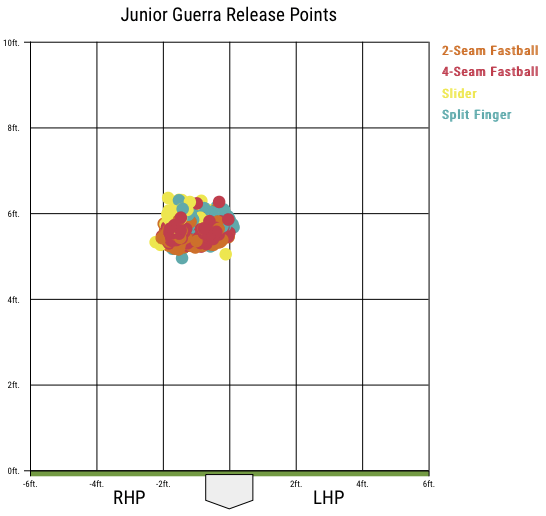
Outside of injury, the primary issue Guerra seems to be faced with is a lack of control. His wide-ranging release points cover two feet horizontally and over a foot vertically. This inconsistency would make it hard for any pitcher to be accurate over a large sample size. If we look at how his vertical and horizontal release points have varied (respectively), it is clear that he is still working on his mechanics:


EVOLUTION ANIMATIONs
Here, we will employ crude animation to illustrate how Guerra’s approach from the mound is shifting. All three of these ‘evolution animations’ will highlight a different feature of his growth. Note that they all cover a three-year range (2016-18) and the date can be found at the bottom. As you approach these try not to over-think them… Instead notice general trends:
PITCH SELECTION BY COUNT


- He is relying less and less upon the four seamer and has largely phased out the curveball.
- His sinker (2 seamer) has become much more prevalent as time has gone on
- Guerra is balancing his pitch selection over every count.
- In 2016, he ONLY threw four seamers when in 3-0 counts
- By 2018, he is throwing three pitches in the same situation
- This expansion in pitch distribution can be seen across the board (it’s why the diagram gets prettier as it ages!)
PITCH TYPE BY LOCATION


- We will make this one simple (even though it is not)!
- 2016: Fewest pitches to choose from; attempts to work in a glove-sided fashion but ends up catching more plate than he would like to (especially high and down the middle!)
- Misses low a lot with his off-speed stuff
- 2017: Adding the sinker and slider more definitively to the mix
- Starts working more centrally but continues to miss low often
- 2018: He has now balanced the distribution of his four pitches and uses them all over the strike zone
- His misses are closer to the edge of the plate
- He pounds the zone more reliably
- 2016: Fewest pitches to choose from; attempts to work in a glove-sided fashion but ends up catching more plate than he would like to (especially high and down the middle!)
Pitch Speed x Horizontal Movement
NOTE: horizontal motion is more typically utilized with his ‘two-seam’ approach. Specifically, sinkers and splitters drop… exactly why they produce high ground ball rates.


- As time progresses we see that each color tends to cluster more closely
- This implies that Guerra is learning to be more consistent and delivering pitches in a much more reproducible manner.
- Junior Guerra’s SLIDER (the red dots) illustrates this improvement very nicely (even his rarely used CURVE is being delivered in a consistent fashion by 2018)
THE RESULTS
Batting Average On Balls In-Play (BABIP)
This is a good metric to assess how hard opposing hitters are hitting each pitch. Simply put, it represents how often non-homeruns fall for hits. While luck and defense factor into the equation, they have less of an effect as sample size grows…


- After dominating with the sinker in 2017, Guerra decided to consciously use it more. As mentioned above, he threw it 500 more times in 2018 than he did in 2017!
- Unfortunately, hitters were no longer fooled by the pitch last year.
Slugging Percentage (SLG%)


- Slugging percentage paints a more mixed picture and tells a different story
- The sinker is getting hit the hardest (as alluded to above) but…
- The splitter is better than we have seen to this point. Consistently effective!

INTERPRETATIONS / CONCLUSIONs
- After being signed as a catcher in 2001, Junior Guerra has continually reinvented himself and adapted to survive. The same flexibility fuels the evolution of his pitching style.
- He has produced mixed results as a starter but is now healthy and transitioning into the bullpen.
- While the sample size is small, he has pitched well as a reliever over his career.
- After starting very hot in 2018, the injury bug bit Guerra again and as a result, he struggled in the second half
- 2019 will present another chance for him to flourish
- Even though Junior Guerra is using a more balanced pitch arsenal than ever before, he is not seeing linear improvement.
- Last year, he threw his sinker much more than in the past
- It also is the pitch that opposing batters hit the hardest (?)
- One can assume that Guerra will shift the balance to better highlight his strengths in 2019
- Last year, he threw his sinker much more than in the past
- Guerra throws with average velocity and utilizes a two-seam approach (dropping / sinking pitches that lead to a high ground ball rate). His 34 year-old arm does not show signs of losing velocity…
- Instead, he struggles with accuracy as a byproduct of an inconsistent delivery (i.e. release points)
- Evolution Animation Summary
- After having a great deal of success with the sinker in 2017, he may have overestimated it. Hopefully, Guerra recognizes this and leans more upon his strengths (i.e. the splitter)
- Junior Guerra’s overall pitch location suggests that his accuracy and control are improving. He is better at painting the corners than he was several years ago.
- He is still learning to deliver his pitches in a consistent fashion. That said, the improvements are undeniable and suggest he can take the next step.
- It is tough to predict how Junior Guerra will perform in the coming year with his shift to the bullpen. That said, Counsell could really be onto something since Guerra:
- Does significantly better against hitters the first time through the order (TTO)
- 1st TTO: 0.209 AVG / 0.317 OBP / 0.354 SLG
- 2nd TTO: 0.268 AVG / 0.342 OBP / 0.485 SLG
- Has pitched better as a reliever (historically)
- Starter: 0.321 wOBA
- Reliever: 0.266 wOBA
- Gets injured when used too much
- Can comfortably use four different pitches in almost any situation
- Has been immune to leverage / pressure
- Is in a contract year on a team thinking, “World Series or bust”…
- Does significantly better against hitters the first time through the order (TTO)