


There are not too many people on the planet who can own the nickname ‘playboy.’ Troy Stokes Jr. is one of them and the five tool phenom is on the rise. After being added to the 40 man roster in November, it is clear The Milwaukee Brewers are invested in the 22 year old left fielder. An in-depth review of his progress from Rookie Ball to Biloxi (AA) helps us understand why.
PLATE PRODUCTION
A good place to start the analysis is with overall plate production. Looking at how often a batter ‘gets on’ (i.e. OBP) is an easy way to estimate overall offensive value. wOBA then takes this idea further and attempts to credit a hitter for every possible outcome at the plate. The trends over Stokes’ Minor League career:


- OBP trends down and starts to stabilize around 0.340 (league average is ~0.320)
- Since 2016, Weighted On-Base Average (wOBA) narrows to the 0.350-0.360 range which is impressive on its own. When we contextualize these stats, it becomes clear we could have A Star on our hands…
CONTACT
BABIP (Batting Average On Balls In-Play) doesn’t hold much water until a hitter gets to 800 plate appearances. It measures how often a non-homerun falls for a single, double or triple. Once the sample size grows large enough, it is a good measure of how hard the player is hitting the ball (or the quality of contact). After that, deviations from baseline imply the player will regress back to their ‘personal mean.’ Given enough PAs, the average Major League Hitter will have a BABIP of about 0.300. For players who are consistently above or below this mark, talent is to blame in both cases.

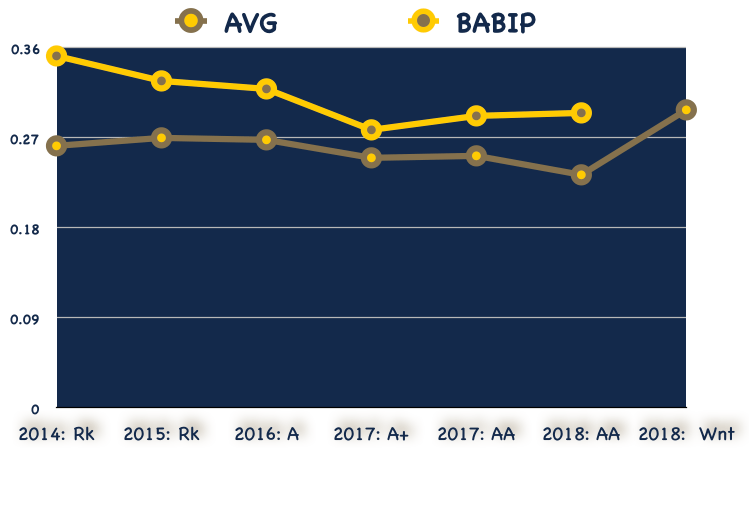
End Points (2018): AVG 0.298 (Winter league, 110PAs) / BABIP 0.295 (BLX, 551 PAs)
- Batting average is pretty steadily in the 0.260 range until a spike up to 0.298 in winter league. A sign of things to come?
- BABIP starts high but trends down and settles in the .300 range which is fairly typical of most hitters. This allows us to know that the statistics that we are reviewing here are reliable indicators of his talent level (As opposed to being a byproduct of poor competition and / or luck).
- The two statistics focused upon here combine to tell us that we have a hitter that can be counted on to be around the 0.270 line… a very solid mark.
RATE STATS (K% / BB%)
How often a player hurts (K%) and/or helps (BB%) himself is relatively predictive of talent level and future success. A young player that can distinguish between balls and strikes already has a good foundation to build upon. While Stokes strikes out at a high rate, he walks at an even higher one.


- BB% hovers around the 10-12 mark which is excellent by any standard. He has been patient at the plate from the start (MLB average typically is around 8-9)
- K% rate goes from pretty good and getting better to fairly poor over the last two years. It continues to trend in the wrong direction
- A likely explanation for these divergent numbers would be a hitter attempting to hit the ball with more authority. For that theory to be true, we would need to see Stokes’ power numbers to be trending up…
POWER
The two metrics used here are relatively straight-forward. Slugging percentage has been around and even most casual fans understand its significance. Literally, total bases divided by at-bats.
Isolated power (ISO), while less common, is just as simple. To calculate it all one must do is subtract a player’s batting average from his slugging percentage. ISO is a measure of ‘raw power.’


- Above, we learned that Stokes is looking to be about a 0.275 hitter. Last year his slugging percentage was up from 0.331 in 2014 all the way to .447…
- Of note, the dip in ISO (in the face of a rising SLG%) tells us that Stokes production is progressively less reliant upon the long ball. A well rounded player, indeed.
- What we know so far: Stokes makes consistently solid contact, hits for power and is stabilizing his production at what projects to be an everyday Major League Starter (at least).


SPEED / BASERUNNING
A very straightforward, yet powerfully predictive metric is stolen base percentage (SB%). It is what most Major League Clubs use to see if they will allow a player to steal or not. After all, it is a big risk to send a runner… losing a potential run is typically not worth the risk. That is, unless a baserunner can steal bases at a clip greater than 70%. Guys above this are considered “base stealers” and get the steal sign much more than the players below it.


We already deduced Stokes is a stud at the plate and now we find out that he is better at running bases. There is no question that he is in elite territory when we consider the numbers. The graph above makes it easy to see that he is well above the ‘steal sign line’ but… His SB% is 86% over his minor league career!!!

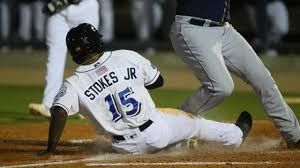


That might not mean much so let me show you a list of the active career SB% leaders. Stokes mark would rank him the best base stealer by almost 2 full percent amongst active MLB Leaders:
Wow… the kid has a vast abundance of talent no matter where he have looked. Let’s see if his fielding continues the trend of greatness.
FIELDING
OK… I’ll cut to the chase… and I am not making this up. Last year, Troy Stokes Jr won a gold glove for his play in left field!
Range factor per game gives us a good idea of a player’s defensive talent level in the field. We can see the trend is (AGAIN) a positive one:


CONCLUSIONs
- Looks like we have a budding All-Star in our midst.
- He has all five tools.
- He is exceptional in regard to all of them.
- If Stokes continues the trends of his minor league career thus far, it will be hard to keep him off of a Major League field.
- If you don’t know Biloxi Shucker Baseball, now might be the time to get acquainted… This guy is good. The Playboy is knocking and will probably soon demand your attention anyway.