


Chase Anderson took a step backwards in 2018 and did not finish the season a part of The Milwaukee Brewers Starting Rotation. BREW MATHs breaks down what changed and how much to expect from the 31-year-old righty in 2019.


- Anderson is entering his sixth year in The Bigs after being drafted by the Diamondbacks in the ninth round of the 2009 Draft.
- Over two seasons with Arizona, he went 15-13 and showed flashes of promise
- The Brewers signed him in 2016 and he went 9-11 with a 4.29 ERA in his first season with Milwaukee
- In 2017, he performed much better and posted a 12-4 mark with a 2.74 ERA.
- In 2018, his record fell to 9-8 with a 3.93 ERA. He also gave up more home runs than any other pitcher in The Major Leagues (30).
- If we glance at his Statcast Rankings, above on the right, we see a lot of blue dots (poor) with two red ones (great).
- Anderson excelled in minimizing quality of contact last year but not much else
- Widening our scope will lend context to the analysis…


CAREER TRENDS
BATTED BALL

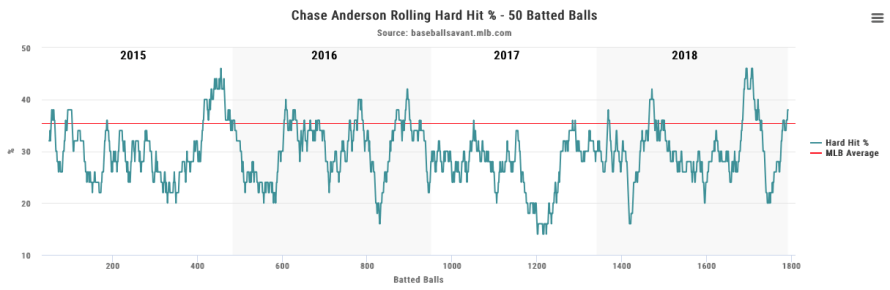
We see that opponents have been kept to a relatively low hard hit % from 2016 to mid 2017. However, since that time batters have been making increasingly better contact with his pitches. The corresponding rise in opponents ‘expected wOBA‘ reinforces how he has been hit harder since mid-season of last year:

Since the beginning of his career, hitters have done ‘about average’ against Anderson except during his surge in 2017. If we focus more closely on the things he can control (FIP / xFIP), similar trends persist:
ADVANCED METRICS


- Where Earned Run Average (ERA) is partially a byproduct of defense, Fielding-Independent Pitching (FIP) is calculated using only HRs, Ks, BBs, HBPs and innings pitched.


- Expected Field-Independent Pitching (xFIP) replaces HRs with ‘expected HRs’ which is calculated as follows:


- Anderson’s FIP is rising much faster than his xFIP telling us he is giving up more HRs than one would expect based on his fly ball rate)
- This could be a byproduct of regressing skills and/or just bad luck… looking at Anderson’s rate stats lends us more insight:
RATE STATs

How often a pitcher strikes out and walks batters are known as rate stats. They are directly under a pitcher’s control and have been shown to be more predictive than most other metrics. Believe it or not, Anderson’s career numbers are EXACTLY the league average:
- K% – 20.0 (MLB Average – 20.0)
- BB% – 7.7 (MLB Average – 7.7)
Anderson is not going to thrive by overpowering hitters. Instead, he welcomes contact with the idea that it will be sub-optimal. This less than optimal contact ideally leads to playable balls. Unfortunately, for Chase that is not how things have been going:


When an escalating fly ball percentage is combined with a rapidly rising home run / fly ball rate (HR/FB), bad things happen. Hence, Anderson gave up more HRs than any other pitcher in 2018. At the same time, we can see how much success he had in the same regard just a year prior. It begs the question: Who will show up in 2019?
Looking more closely at Anderson’s approach might help us understand…

PITCH ARSENAL
A BALANCED CAREER


- The four seam fastball is used, far and away, the most (40.6% of the time) and comes in at average velocity (93 mph)
- His circle change has been his best pitch and used almost 20% of the time
- It comes in around 83 mph and has glove-sided fade
- The curve ball also been effective for Anderson at 77 mph with a sharp downward bite
- His other two pitches have been less effective historically (sinker, cutter). They are used the least and are mixed in strategically… Less so in 2018.
- All five of these pitches lead to higher than average fly ball rates
- Notice the balanced deployment of these pitches – Over his career, he keeps hitters on their heels and punishes them for guessing
- However, in 2017, Anderson started leaning disproportionately on his fastball. In 2018, the lack of balance compounded.
AN IMBALANCED 2018


This trend is especially troubling when we realize that Anderson is shying away from his strengths and walking into his weaknesses. Specifically, he is using the fastball progressively more. This limits the use of his more effective pitches (i.e. change, curve):


DECLINING VELOCITY
On top of the mounting imbalance and an inefficient approach, Anderson dropped velocity across the board in 2018:

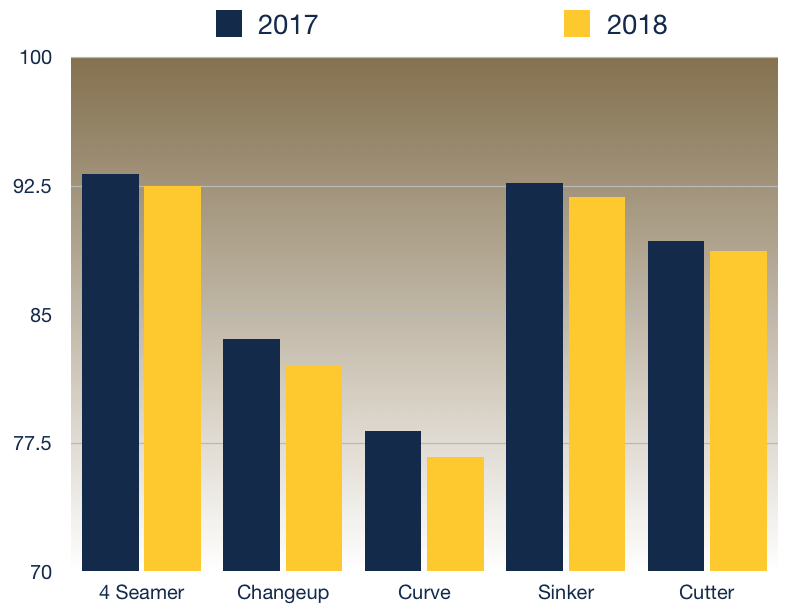
A pitcher with a ‘league average’ fastball cannot earn a living trying to throw pitches past people… Anderson learned this the hard way in 2018:


QUALITY OF PITCH (QOP / QOPA)
If we mine deeply into the data and use Statcast PITCHf/x data, the whole story begins to surface:


- While Anderson’s overall quality of pitch (QOP/QOPA) remained steady from 2017 to 2018, individual pitches show varying trends:
- Fastballs are below ‘MLB average’ and are declining in terms of quality. Despite this, they are still thrown 300 more times in 2018.
- Anderson’s offspeed stuff is above ‘MLB average’ and improving in terms of quality. Yet, it was used relatively less as 2018 went on.
REAL REASONS FOR HOPE
When compared to the pitchers at the top of The Brewers staff, Anderson is just as good at keeping batters off the basepaths. In fact, since 2015 Anderson has been better at it and graphing WHIP proves it:


Anderson also is improving in terms of:
- Limiting quality contact (outside of HRs)
- Batting Average On Balls In-Play (BABIP)
- Stranding runners on base (i.e. clamping down when his back is against the wall)
- Left On-Base Percentage (LOB%)


INTERPRETATIONs / CONCLUSIONs
- Chase Anderson is a ‘control-based’ pitcher that uses deception and a wide array of pitches to limit quality of contact
- Anderson has pitched very close to league average over his MLB career.
- In 2017 it seemed that he was putting things together and thrived using a balanced approach that revolved around his changeup
- However, in 2018 he began throwing predominantly fastballs
- Since Anderson has a below average fastball, this approach was exposed and his performance / stats suffered.
- Anderson is a ‘fly ball pitcher’ who will only thrive if he is keeping balls in the park.
- Last year, he gave up more home runs than every other pitcher in baseball
- While some of that can be attributed to random chance / luck, he clearly did not have the ‘same stuff.’
- Since Anderson cannot blow hitters away with his velocity, he is even more dependent upon accuracy, selection and sequence.
- Last year, he gave up more home runs than every other pitcher in baseball
- Anderson dances the line of effectiveness with his skill set. Thus, his career has often led to a mixed bag of results.
- Counsell is learning how to use the righty who can consistently eat up early innings. Anderson really struggles after facing the lineup twice.
- If he is asked to do too much or go too deep into games, he usually gets into trouble
- Anderson is still in the prime of his career and should be able to reclaim his ‘2017 form’ if he can rebalance his approach and be more thoughtful with sequencing.
- He has good command with five pitches and can thrive even in the face of lower velocity. That said, if his pitches continue to slow down Anderson could be facing a very rough 2019.
- Watching his velocity at the open the season will be a good indicator. Brewers Fans should hope for fastballs that are 93 mph or better. If he is averaging lower than 92 mph there is reason for concern.
- He has good command with five pitches and can thrive even in the face of lower velocity. That said, if his pitches continue to slow down Anderson could be facing a very rough 2019.
- Chase Anderson can definitely get his groove back. After all, he tends to perform best with his back against the wall…
- 2019 approaches quickly!
